Acne Treatment Montreal for Clearer, Healthier-Looking Skin
Acne does not always respond to the same skincare routine, and treating visible breakouts is only one part of understanding acne-prone skin. At GLIF Medical, acne treatment in Montreal combines laser treatment with professional topical care to address active inflammatory lesions, oily-prone skin and the overall appearance of the skin.
Rather than applying a standard treatment to every patient, the approach begins with an evaluation of your skin, the type and severity of your acne and the routine you already use at home. This allows Dr. Peguy Télusma, MD, and the clinical team to determine whether laser and topical care are appropriate for your particular skin condition.
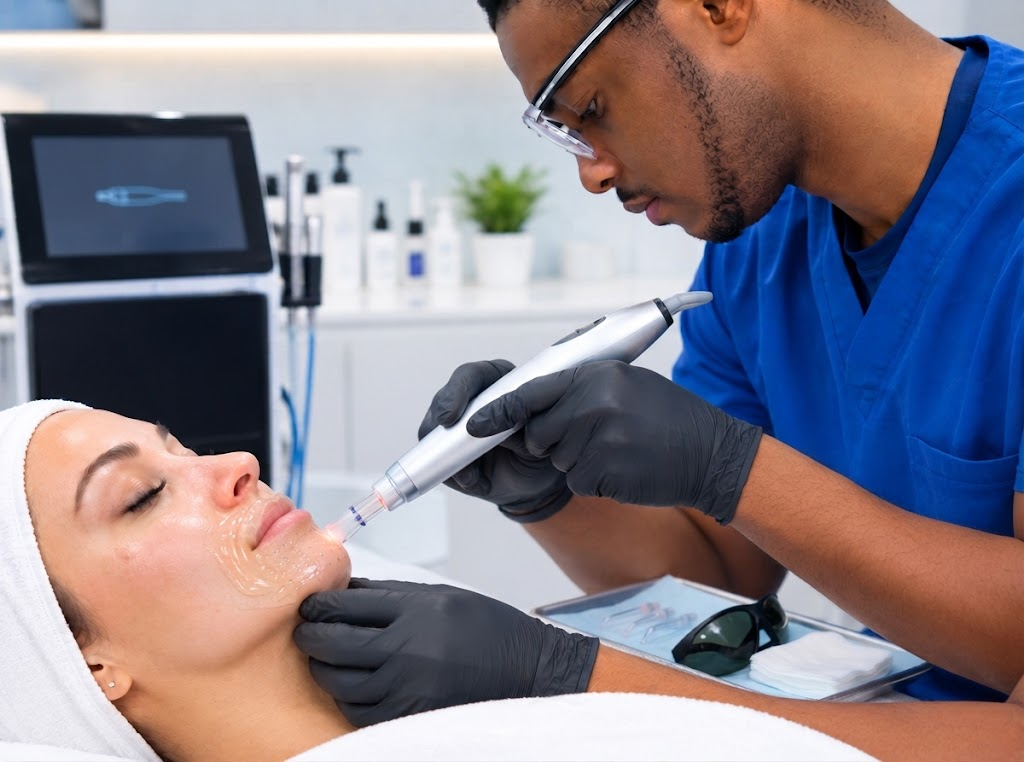
The treatment is non-invasive, takes approximately 30 minutes and generally involves minimal to no downtime. The objective is a progressive, temporary reduction in inflammatory acne lesions and an improvement in the overall appearance of acne-prone skin.
What Is Acne Treatment in Montreal at GLIF Medical?
GLIF Medical offers a combined approach using laser treatment and professional topical care. The two components complement each other and are selected according to the skin condition observed during your evaluation.
The laser component addresses superficial inflammation and skin texture, while professional topical care applied in-clinic complements the treatment by targeting factors such as sebum production and pore appearance.
This treatment is designed as an esthetic complement to your skincare routine. It does not replace medical acne care when prescription treatment, investigation of an underlying cause or other medical management is required.
| Treatment component | Purpose |
|---|---|
| Laser treatment | Addresses superficial inflammation and supports improvement in skin appearance and texture. |
| Professional topical care | Complements the laser approach by targeting sebum production and pore appearance. |
| Skin evaluation | Helps determine whether the combined treatment is appropriate for the type and severity of acne observed. |
How Does Acne Laser and Topical Treatment Work?
The treatment combines two complementary steps. The laser is used to address superficial inflammation and skin texture, while professional topical care is applied in-clinic according to the condition of the skin.
Laser Treatment for Acne-Prone Skin
The laser component is intended to address superficial inflammatory changes and support an improvement in the appearance and texture of acne-prone skin. Laser settings are selected according to the skin observed during the evaluation rather than using identical settings for every patient.
Professional Topical Care
The topical component complements the laser treatment by targeting factors such as sebum production and pore appearance. The professional topical care is selected and applied by the clinical team based on the patient’s skin condition.
Your existing skincare routine is also considered. This is important because active skincare products and other treatments may affect how acne-prone skin should be managed.
Who Is This Acne Treatment For?
This treatment may suit people with active inflammatory acne lesions or oily-prone skin who want to improve the appearance of their skin. It is intended for people looking for an esthetic complement to their routine rather than a replacement for medical acne care.
An acne treatment consultation may be appropriate if you are experiencing:
- Recurring inflammatory acne lesions
- Oily or acne-prone skin
- Visible pore appearance
- Breakouts that continue despite your existing skincare routine
- Uneven skin texture associated with acne
- Acne concerns that affect your confidence or daily comfort
The treatment can be considered for both teenagers and adults. However, acne can have different contributing factors depending on age, hormonal context, medications and individual skin characteristics.
Why Is an Acne Evaluation Important?
Acne is not always purely a cosmetic concern. Persistent or more severe acne may be influenced by hormonal, dermatological or other factors that require dedicated medical management.
During the consultation, Dr. Peguy Télusma assesses the skin, the type and severity of acne and the skincare products or routines already being used. This helps determine whether the GLIF Medical approach is suitable.
If the evaluation suggests that another form of acne management would be more appropriate, this can be discussed before proceeding with an esthetic treatment.
For additional Canadian patient information about acne, you can consult the Canadian Dermatology Association’s acne information.
What Happens During an Acne Treatment Session?
An acne treatment session lasts approximately 30 minutes. The exact sequence depends on the treatment plan established during your evaluation.
- Your skin and current acne condition are assessed.
- Appropriate laser settings are selected according to the skin condition.
- The laser component is performed.
- Professional topical care is applied according to the treatment plan.
- Aftercare and the recommended treatment schedule are discussed.
The treatment is non-invasive, and downtime is generally minimal to none. Mild, temporary redness may occur following the session.
What Is Acne Treatment Recovery Like?
Recovery is generally straightforward, with minimal downtime expected after treatment. Some temporary redness may occur, but most patients do not require significant recovery time.
Individual responses can vary depending on the condition of the skin and the treatment performed. The clinical team provides appropriate aftercare recommendations following your session.
Following the recommended skincare routine is important. Avoid unnecessary irritation and use only the products recommended or approved for your skin following treatment.
How Many Acne Treatment Sessions Are Needed?
The number and frequency of sessions are not identical for every patient. The recommended schedule is determined during the consultation according to the severity of acne and the response to treatment over subsequent sessions.
Some people may benefit from a series of treatments, while others may require a different approach depending on their skin condition. The plan can therefore be adjusted according to the response observed over time.
Maintenance may be recommended because acne is an evolving condition and breakouts can return as contributing factors change.
What Results Can You Expect From Acne Treatment?
The expected result is a temporary reduction in inflammatory acne lesions and an improvement in the overall appearance of acne-prone skin. Results may develop progressively and vary from person to person.
Depending on your skin condition, treatment may support improvement in:
- The appearance of inflammatory acne lesions
- Oily-looking skin
- Visible pore appearance
- Overall skin texture
- The general appearance of acne-prone skin
Results vary according to the type and severity of acne. Because acne can evolve over time, regular maintenance and an appropriate home-care routine may help support the benefits observed between sessions.
Can Acne Treatment Prevent Future Breakouts?
Acne treatment cannot guarantee that future breakouts will be prevented. Acne is an evolving condition influenced by factors that can change over time, including hormonal fluctuations, age, skincare habits and other individual factors.
The purpose of treatment is to support improvement in the appearance of active acne and acne-prone skin. Maintaining a consistent home-care routine and following the recommendations provided during consultation can help support results.
If lesions persist or become worse despite treatment, a medical reassessment is recommended.
How Should You Care for Acne-Prone Skin at Home?
Professional acne treatment should work alongside an appropriate home-care routine. The ideal routine depends on your skin and should take into account any professional or prescription products you already use.
- Cleanse the skin gently rather than scrubbing aggressively.
- Avoid picking or squeezing acne lesions.
- Choose skincare products appropriate for acne-prone skin.
- Follow the skincare recommendations provided by the clinical team.
- Use appropriate sun protection as part of your regular skincare routine.
- Tell the clinical team about active skincare products or prescription medications before treatment.
If acne has also left uneven texture or depressed scars, explore our guide to fractional CO2 laser treatment to learn how laser resurfacing may help improve selected scars and skin-texture concerns.
What If Acne Has Caused Scars?
Active acne and acne scars are different concerns and may require different treatment approaches. When inflammatory acne is better controlled, residual scarring can be assessed separately.
The appropriate option depends on the type, depth and appearance of the scars as well as the condition of the surrounding skin.
GLIF Medical offers complementary options such as microneedling and fractional CO2 laser resurfacing for appropriate patients following an evaluation.
Learn more about microneedling in Montreal, including its benefits, treatment process and expected results, to understand another option for improving the appearance of acne scars and uneven skin texture.
You can also explore the clinic’s dedicated information about acne scars and treatment options.
Is This Acne Treatment a Replacement for Medical Acne Care?
No. The GLIF Medical treatment is an esthetic complement and does not replace medical evaluation or medical management when required.
An evaluation can help determine whether an underlying hormonal or dermatological cause should be investigated separately. Patients with persistent, worsening or more severe acne may require a dedicated medical acne treatment plan.
This distinction allows the treatment to remain focused on improving the appearance of acne-prone skin while recognizing when additional medical care may be appropriate.
Why Choose GLIF Medical for Acne Treatment in Montreal?
GLIF Medical provides physician-led medical-esthetic care at its clinic in Verdun, Montreal. The approach starts with understanding the patient’s skin rather than automatically recommending the same procedure for everyone.
- Physician-led evaluation: Acne and skin condition are assessed before treatment.
- Personalized approach: Laser settings and topical care are selected according to the skin condition.
- Combined treatment: Laser and professional topical care work as complementary components.
- Montreal location: Treatment is provided at the GLIF Medical clinic in Verdun (Île-des-Sœurs).
- Ongoing assessment: Treatment frequency can be adapted according to the response observed over time.
Acne Treatment Montreal: Treatment Details
| Treatment detail | Information |
|---|---|
| Treatment type | Laser treatment with professional topical care |
| Session duration | Approximately 30 minutes |
| Downtime | Generally minimal to none |
| Possible temporary effect | Mild temporary redness |
| Provider | Dr. Peguy Télusma, MD |
| Location | 14 Place du Commerce, Suite 430, Verdun (Île-des-Sœurs), Montréal, QC H3E 1T5 |
What Is the Next Step for Acne Treatment in Montreal?
The first step is a personalized consultation. Dr. Peguy Télusma can assess your skin, the type and severity of acne and the skincare routine already in place.
This evaluation guides the choice of laser settings and professional topical care used in-clinic and helps establish a realistic treatment schedule based on your skin and goals.
If the appearance of acne scars remains a concern after inflammatory acne is better controlled, complementary treatment options can also be discussed as part of a broader skin-care plan.
Book Acne Treatment in Montreal
Take the first step with a personalized assessment at GLIF Medical and discuss the most appropriate approach for your acne-prone skin.
GLIF Medical
14 Place du Commerce, Suite 430
Verdun (Île-des-Sœurs), Montréal, QC H3E 1T5
Phone: 514-665-0558
Last updated: October 09, 2026